
Lipscomb Release Date Labels
TDCJ defines a Projected Release Date as the date its Classification and Records Office calculates if the person is not paroled sooner. The field can reflect mandatory-supervision rules, calendar time, and good-conduct time. It does not show that the prison gate was crossed. A Scheduled Release Date appears only after processing has moved further, and may be paired with Scheduled Release Type and Scheduled Release Location. Maximum Sentence Date is a sentence endpoint. Parole Eligibility Date is merely the first point at which the case may qualify for review.
A Lipscomb County Jail detainee may be awaiting trial, serving a county sentence, or waiting on transfer. A pretrial case turns on bond and court orders, not a TDCJ formula. Even a sentence marked time served needs an authorized release order and an operational jail timestamp. Another warrant or detainer can keep custody in place.
Scheduled versus actual: A date label forecasts or plans an event. The sheriff or TDCJ release record confirms the event that actually occurred.
Find Lipscomb Projected Release Dates
First identify the custodian. The TDCJ inmate search covers current state prisoners, not every person once held in Lipscomb County Jail. Search by TDCJ number when possible. The seven-digit number avoids many name errors; a SID number is another strong identifier. Name searches require the full last name and at least the first initial, with date of birth, race, or sex available to narrow a match.
- Ask whether the person is in the county jail, TDCJ custody, another jail, or federal custody.
- For TDCJ, search the exact identifying number or carefully matched name and open the current detail.
- Record each label separately: Projected Release Date, Parole Eligibility Date, Maximum Sentence Date, and any Scheduled Release fields.
- For a county sentence, call the sheriff and request the jail release calculation and authorized order.
- Request the signed judgment, jail-credit finding, and later orders from the combined County and District Clerk.
- Confirm the actual event with the agency holding the person on the date in question.
The full Lipscomb County release record path helps when a person has already left the current roster. TDCJ's search form is shown in the project manifest. Open the official TDCJ search before viewing the capture.
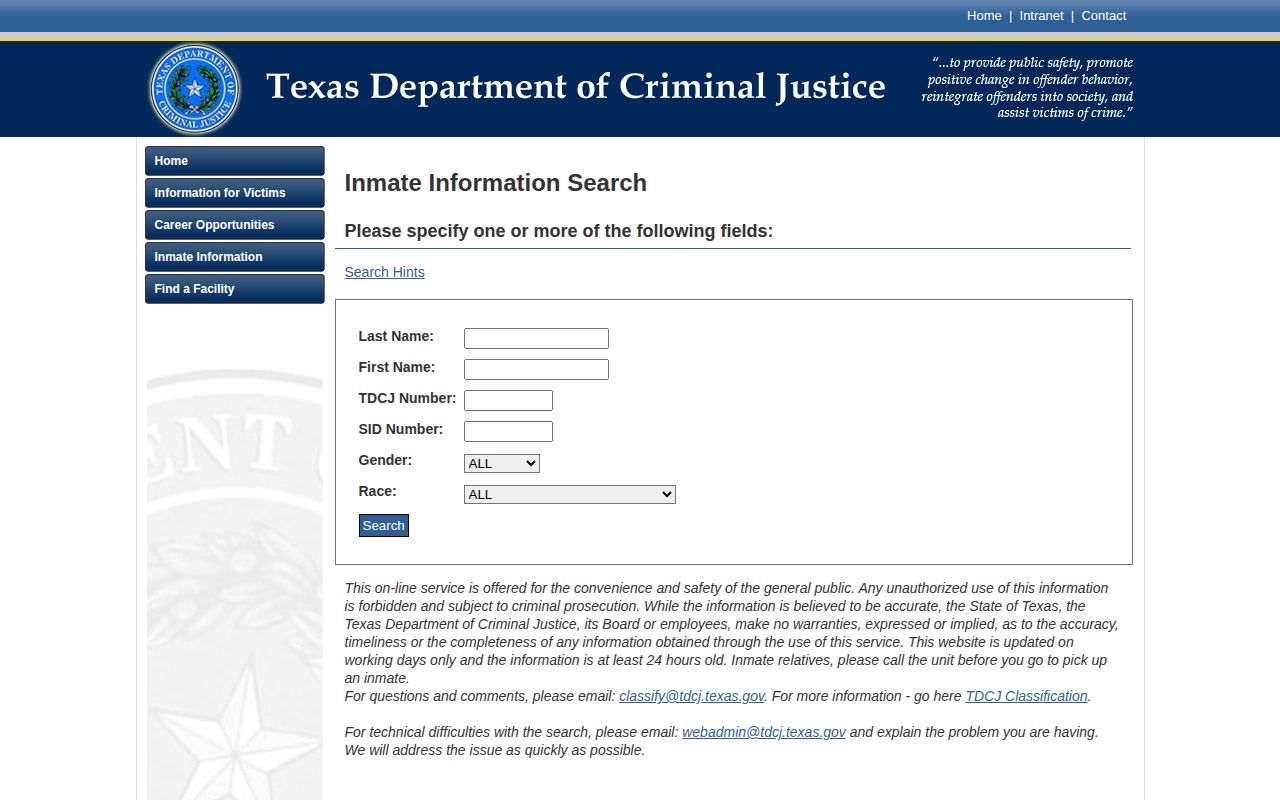
The form's identifier fields are the safest route to the correct current prison record; the resulting labels still require careful interpretation.
Texas Good Time and Lipscomb Dates
Texas Government Code Chapter 498 controls good-conduct time. Section 498.003 says those credits affect eligibility for parole or mandatory supervision but do not otherwise cut the sentence term. Good time is a privilege. The amount can depend on classification and participation, can be forfeited, and may be restored under the governing rules. The law that applies also depends on the offense date.
Mandatory supervision is release under state supervision when the governing formula and eligibility rules are met. For eligible offenses before September 1, 1996, calendar time plus good-conduct time reaching the sentence can drive the projected date. For eligible later offenses, Board approval also matters. A denial may move the projection to maximum expiration, while later approval can shift it forward. If the person is not eligible, the projection generally tracks maximum expiration based on calendar time.
Texas has no blanket rule that all TDCJ prisoners serve 85 percent. Government Code Chapter 508 contains several formulas. Some aggravated or listed cases use one-half of the sentence or 30 years, whichever is less, in actual calendar time without good time. Other cases often use calendar time plus good time reaching one-fourth of the sentence or 15 years, whichever is less. Offense, date, enhancement, and consecutive sentences can change the rule. The live TDCJ field is safer than a hand calculation.
Why Lipscomb Release Dates Change
A projected date is a working calculation based on the record then held by the agency. New credits, discipline, a corrected sentence, or Board action can move it. Some events do not change the sentence end but still delay release to the community. A detainer, for example, can cause transfer to another custodian on the planned date.
| Factor | Possible effect | Best confirmation |
|---|---|---|
| Good-time class or forfeiture | Changes credit used in an eligibility or mandatory-supervision calculation. | TDCJ Classification and Records |
| Parole vote | May authorize an earlier path, deny release, or require a program first. | Board review status and Parole Division |
| Court order or corrected judgment | Changes sentence, jail credit, bond, or release authority. | Signed clerk record |
| Detainer or hold | May send the person to another agency rather than the community. | Current and receiving custodians |
| Consecutive sentence | Requires one term to interact with another before release. | TDCJ sentence detail |
| Release processing | Adds a scheduled date, type, and location as plans become firm. | TDCJ Release Processing |
A favorable Board code is not an exit date. FI-1 may mean release when eligible, FI-2 points to a future month and year, and program-linked FI codes add prerequisites. NR is a denial with a later review date. Read the whole decision rather than extracting one date.
Lipscomb County Date Channel Sweep
Lipscomb County publishes no jail roster, projected-date calculator, standard discharge hour, weekend practice, or online release archive. The local access-channel sweep therefore starts with the sheriff at 806-862-2611 as the operational source. A focused written request should seek the sentence calculation, jail-credit entry, authorized release order, recorded time, type, and destination.
The combined County and District Clerk holds the case papers. Ask for the charging instrument, signed judgment, sentence, jail-credit finding, bond or release orders, and later discharge or revocation papers. The clerk file explains legal authority; the jail file shows the physical movement. Neither should be asked to create a new forecast or legal opinion.
TDCJ offers another channel when the person is a state prisoner. Its inmate information page lists an email route through pia@tdcj.texas.gov and says basic information can include the projected release date without a charge. It asks for the name and TDCJ number, or exact birth date or approximate age and county of conviction when the number is unknown.
The official alternate channel is pictured in the manifest. Review TDCJ's phone and email options before the image.
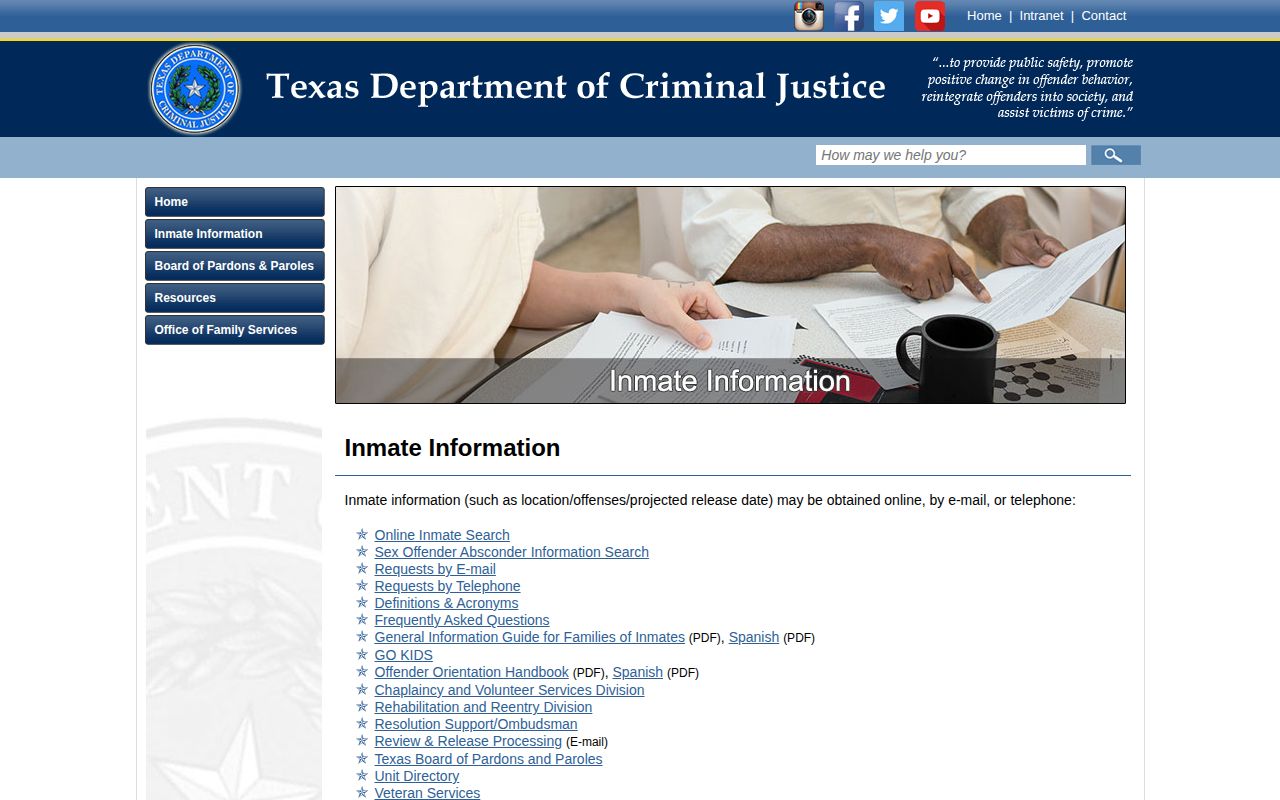
These routes help when the current search fails, and they keep the request tied to the official record custodian.
Confirm Lipscomb County Release Dates
A scheduled date becomes historical only after the custodian records the movement. For Lipscomb County Jail, ask the sheriff for the authorized order, exact local time, release code, and destination. Then compare the cause number with the clerk's signed order. Texas jail standards require identity checks, authority to release, a recorded time, and property-return documentation, which makes the release file stronger than a forecast.
For TDCJ, call the release-status line after a favorable vote and compare the response with the detail fields. The Lipscomb County VINELink check can add an alert, but notification is not the release instrument. Preserve the alert wording and time, then verify through Release Processing or the Parole Division.
- Projected
- A calculated date that assumes the current record and no earlier parole.
- Scheduled
- A planned release with processing further advanced.
- Actual
- The event recorded when the person left that custodian.
- Detainer
- A request from another agency that may turn release into transfer.
Always keep the field label and retrieval date. “Projected Release Date: October 1” must never be shortened to “released October 1.”
Lipscomb Release Dates by Custody
A county-jail date and a state-prison date come from different records. At Lipscomb County Jail, staff act on an authorized order, verify identity, record the release time, and document property return. The court judgment supplies sentence and jail-credit facts. If the person is held before trial, no fixed term is running toward a standard discharge date. Bond, a dismissal, a plea, a sentence, or another order may change custody.
TDCJ calculates state-prison fields from its sentence and classification records. Its current search can show Projected Release Date, Parole Eligibility Date, and Maximum Sentence Date, with Scheduled Release fields when applicable. A person may leave TDCJ on parole or mandatory supervision before the maximum date, complete the sentence at discharge, or move to another custodian because of a hold. Each outcome calls for the state release record.
Federal custody uses a separate clock. The Bureau of Prisons locator may display a future projected release date or a past date with “RELEASED.” Credits can alter a future federal date. A BOP result does not settle a state or county hold, and a federal docket is needed for legal outcome. ICE and USMS also use separate records, so no TDCJ calculation should be carried into those systems.
| Custody | Date source | Actual-event proof |
|---|---|---|
| Lipscomb County Jail | Judgment, jail credit, authorized order | Sheriff release sheet and time |
| TDCJ prison | TDCJ projected and scheduled fields | Release Processing or Parole Division record |
| Federal BOP | BOP locator and sentence record | BOP status plus federal docket |
Do not merge these labels into a single answer. State which agency controls the person now, which date field was found, and when it was retrieved.
Parole review adds another date that is often misunderstood. Texas does not hold a formal person-by-person hearing for parole or mandatory-release consideration. Panel members review and vote files. The Next Parole Review Date is therefore not a public hearing appointment and not a promise of release. TDCJ generally identifies files in advance, prepares a case summary, and sends the record to the designated Board office for sequential voting.
Review codes also need context. FI decisions can authorize release when eligible, set a future month, or require a named program. RMS concerns mandatory supervision. A denial may set a later review month. None replaces the Scheduled Release Date or the release-processing confirmation. If the family needs status, the Board review line and Parole Division release-status line answer different parts of the process.
County time calculations should not copy a TDCJ rule. Texas jail standards permit sentence-discharge processing within a statewide daytime window and allow limited preceding-day credit, but Lipscomb publishes no narrower local schedule. The statewide rule is not a pickup appointment. Call the jail before travel and ask whether another cause, warrant, or receiving agency affects the planned movement.
Public Record Search
Sponsored Results